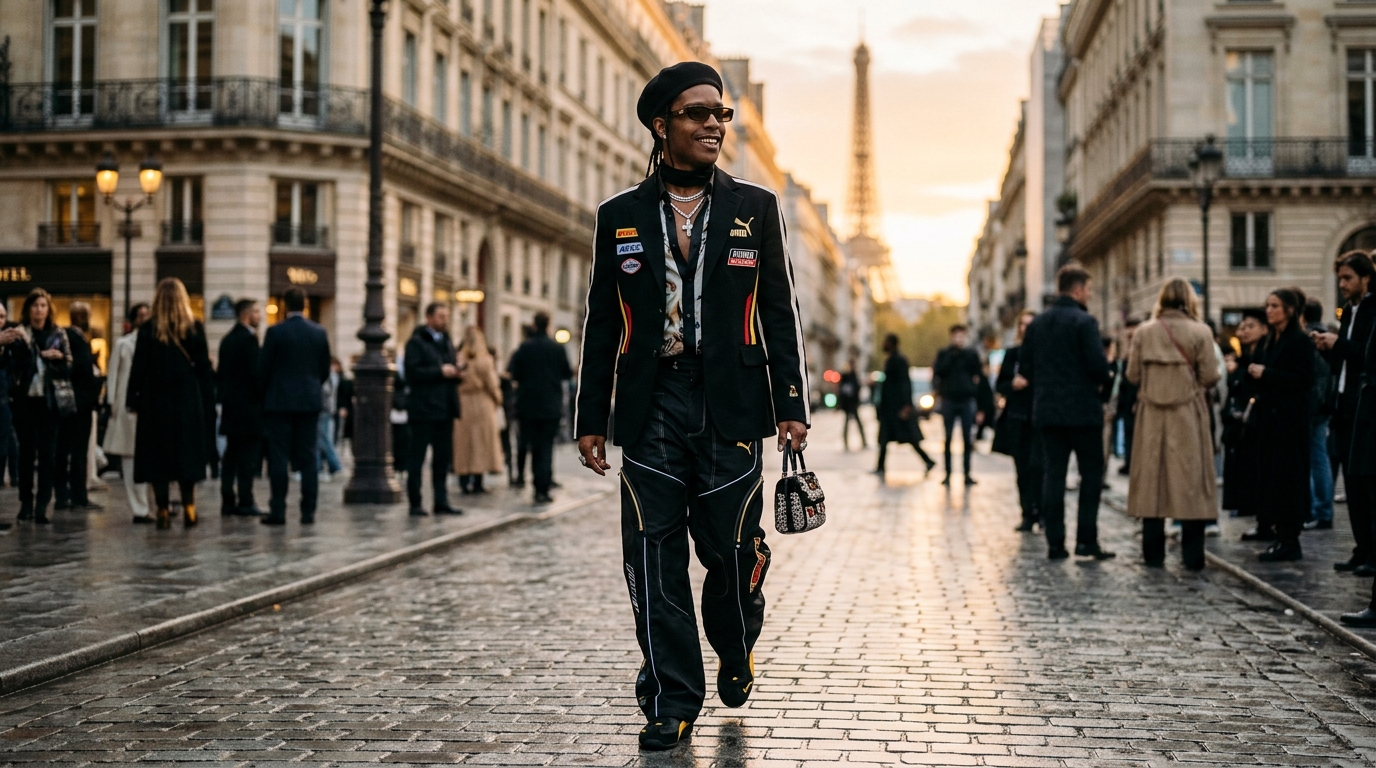
When Rakim Mayers steps onto the cobblestone alleys of the 1st arrondissement during Paris Fashion Week, the visual reverberation is deliberate, steeped in history, and utterly uncompromising. Draped in tailored Italian wool cut with the kinetic precision of Formula 1 fire-suits, topped with a cocked beret and crowned by strands of freshwater pearls, A$AP Rocky is not merely attending the collections—he is orchestrating the current chapter of what scholars and tastemakers have christened the New Black Parisian Renaissance.
For more than a decade, Rocky has stood at the avant-garde nexus of hip-hop and haute couture. But his current commentary on the French capital transcends the traditional streetwear flex. In Rocky's eyes, Paris is not just a commercial launchpad; it is a sacred space of creative sovereignty, where Black American artists can deconstruct systemic American confines and re-emerge as polymath directors of global taste.
Echoes of 1920s Harlem in the City of Light
To grasp Rocky’s modern visual vernacular, one must look back exactly one century to the interwar 1920s, when Harlem’s most daring minds fled American racial terror and segregation for the creative sanctuary of Paris. When Josephine Baker dazzled at the Théâtre des Champs-Élysées with the Revue Nègre, when jazz giant Sidney Bechet ignited the underground clubs of Montmartre, and when literary giants like Langston Hughes and later James Baldwin found clarity at café tables on the Left Bank, they established a profound cultural pipeline between Harlem and Paris.
In Paris, these luminaries discovered that their Blackness, rather than being an obstacle to institutional recognition, was recognized as the wellspring of 20th-century modernism. Montmartre became known as "Black Montmartre"—a haven where fighter ace Eugene Bullard ran legendary nightclubs, and musicians played until dawn without fear of curfew or indignity.
The Philosophy of Black Dandyism
Black dandyism has never been about mere vanity; historically, it has functioned as a radical weapon of self-possession and psychological rebellion. By adopting the most refined sartorial codes of European nobility and subverting them with African-American swagger, Harlem's expatriates claimed an unassailable dignity. Rocky’s wardrobe—merging pleated trousers, diamond grilles, pearl chokers, and racing gloves—is the modern direct evolution of this centenary aesthetic lineage.
Rocky speaks reverently of this inheritance: "People look at fashion like it started on Instagram yesterday," Mayers noted in recent salon discussions. "Nah, James Baldwin was in Saint-Germain turning pain into immortal prose. Sidney Bechet had Paris dancing to frequencies they'd never felt before. They laid down the carpet. We’re just walking on it in customized shoes."
The PUMA Partnership: Deconstructing the Track and the Runway
Nowhere is this cross-pollination more electric than in Rocky’s ongoing role as Creative Director of the PUMA x F1 partnership and his wider collaborative releases with the German sportswear giant. While previous celebrity brand deals were often restricted to colorway endorsements, Rocky was given complete structural sovereignty over silhouettes, campaign narrative, and material prototyping.
His work with PUMA interrogates the collision between high-speed motorsport ergonomics and bespoke Parisian tailoring. By resurrecting archival low-profile sneakers like the PUMA Inhale and the cult-favorite Mostro, Rocky disrupted the bloated sneaker trends that dominated the past decade, replacing them with sharp, aerodynamic silhouettes that evoke the asphalt of Monaco and the grand boulevards of Paris alike.
The apparel collection takes this duality further: distressed balaclavas crafted from technical Kevlar weaves, quilted driver jackets structured like Parisian morning coats, and technical track trousers tailored with the precision of Savile Row. Rocky treats the racing garage not as blue-collar utility, but as a site of luxury theater—a space where grit meets grandeur.
The New Black Parisian Renaissance
The impact of Rocky’s Parisian presence signals a permanent shift in how Black artists engage with global fashion institutions. No longer content with merely inspiring moods on corporate moodboards, Rocky—alongside visionaries like the late Virgil Abloh and Pharrell Williams—has dismantled the gatekeeping of European luxury from the inside out.
Yet Rocky’s unique contribution remains his fidelity to the streets that made him. The spirit of 125th Street in Harlem is perpetually present in everything he touches in Paris. Whether he is presenting a PUMA pop-up in Le Marais with distressed car bodywork or walking alongside Rihanna through the Tuileries Garden, he embodies the undeniable triumph of Black cultural authorship.
A hundred years after Harlem first set foot on Parisian cobblestones, the dialogue continues. And under A$AP Rocky’s creative helm, the renaissance isn’t just remembered—it is moving at maximum velocity.